
The free access to this article was made possible by support from readers like you. Please consider donating any amount to help defray the cost of our operation.
Thresholds as Affordances for Contemplation: Japanese Exemplars
Aaron Seymour
Abstract
In a world overrun with distraction, how might we as designers create opportunities for more focused modes of experience? Drawing from phenomenology, ecological psychology, and reflective design, this paper examines how thresholds afford contemplative modes of being by dissolving the rigid boundaries between self and environment.
Analyses of case studies from Japanese spatial and material culture, including the entry path at Ginkaku-ji, the domestic genkan, Shinto’s torii gates, the Teshima Art Museum, and packaging, demonstrate how designed interventions can work to choreograph shifts in attention and perception.
By understanding thresholds not just as spatial boundaries but as affordances for contemplative transformation, this paper offers new insight for design practice, suggesting ways that everyday environments may be crafted to support deeper, more mindful modes of experience.
Key Words
contemplative experience; embodied experience; experience design; Japanese spatial culture; thresholds
1. Introduction
What if contemplation is not a retreat from the world, but a mode of moving more deeply into it? This paper begins with the proposition that contemplation is not a purely mental or interior state, but an embodied experience shaped as much by sensory awareness as by thought. It asks how designed interventions might afford such a state of being, that is, how certain objects and environments make possible a shift in consciousness. It examines how thresholds afford contemplative experience, not simply through their character as a spatial boundary but as a liminal condition that patterns our perception, attention, and affective state.
Drawing together insights from phenomenology, ecological psychology, and reflective design observation, this paper establishes an interplay among the non-dual nature of thresholds, affordances, and contemplative states. The author has spent over thirty years traveling throughout Japan, leading design study tours for university students. Through a series of case studies drawn from his own experiences of Japanese spatial culture and insights as a professional designer, this paper explores how thresholds cultivate the conditions for contemplative awareness. It argues contemplation is something fundamentally enacted through the body, a process of situated attunement that emerges through our encounter with the textures and temporalities of the designed world.
2. Contemplation as embodied experience
Contemplation is a fundamentally embodied experience. Rather than conceiving of the mind and body as separate ontological entities, it is more accurate to understand the mind as a component of a feeling, sensing body—a body that is shaped by, and in turn shapes, its environment. Instead of conceptualizing contemplative experience as a withdrawal into mental interiority, a more productive understanding is that of an intensification of embodied awareness: a mode of existence in which sensory, spatial, and affective registers converge to produce reflective experience.
This perspective aligns with Merleau-Ponty’s assertion that “to be a body, is to be tied to a certain world… our body is not primarily in space: it is of it.”[1] For Merleau-Ponty, perception is not the passive reception of data by a disembodied subject, but an embodied act—a ”coming into being” of the world through bodily engagement. The lived body (le corps propre) is not merely situated within a world, but discloses it through its movement and perceptual orientation.
A growing body of research in embodied cognition emphasizes the co-constitutive relationship between the sensing body and its environment.[2],[3],[4] In this work, the body is framed as a dynamic, responsive organism whose posture, breath, movement, and sensory exposure condition the very possibility of sustained reflection. Merleau-Ponty describes this encounter as an interweaving of perception and spatiality: “spatial perception is a structural phenomenon and is comprehensible only within a perceptual field which contributes in its entirety to motivating the spatial perception by suggesting to the subject a possible anchorage.”[5] Shaun Gallagher further reinforces this idea, arguing that perception is an action-oriented bodily engagement and that, unexpectedly, bodily action often precedes cognitive intention.[6]
3. Anchoring thresholds, affordances and contemplation
This paper highlights an intuitive convergence between thresholds, contemplation, and affordances—three concepts that share a capacity to dissolve the rigid Cartesian boundaries between subject and object. By definition, thresholds are zones of liminality that makes possible a shift of some kind. Similarly, contemplation is a state in which conventional dualisms between self and world blur. Affordances too exhibit a non-dual character, neither wholly objective features of the environment nor subjective projections of the mind but relational properties emerging between perceiver and world.
Understood together in this way, thresholds afford non-dualistic contemplative states by marking spatial transitions, and by modulating our perceptual and cognitive rhythms. To design a threshold is to define more than a spatial border. It is to choreograph the conditions for a gentle dissolution of the divide between self and world.
4. Thresholds as liminal affordances
In his ecological psychology, James Gibson defines affordances as the “action possibilities” available in an environment relative to a person’s capacities.[7] Yet the affordances of a threshold go beyond the simple function of demarking space. They are also phenomenological. A temple gate, for example, does more than direct movement; it reshapes the visitor’s mode of being. As we shall see in the case studies, its spatial and material properties attune one’s awareness to the shift from the profane external world to that of the temple’s inner sacred precincts. Alva Noë argues that perception is not passive reception but “a kind of skillful bodily activity”[8]—we perceive the world through action, through patterns of movement and bodily engagement: touch, breath, temperature, pace, balance, light. Conceived in this way, thresholds act as more than spatial barriers—they afford perceptual transitions through actively reconfiguring the body’s relation to space.
This liminal quality is what sets thresholds apart from everyday boundaries. A threshold is not just a thing, but also an experience that triggers a shift in awareness. Bending to crawl through the low entrance of a Japanese tea ceremony room or gently sliding a delicate fusuma (sliding paper screen) dividing two rooms involves more than a physical movement—it requires focused somatic engagement. The body adjusts, and in doing so marks a moment of spatial and psychological transition.
This liminality applies both to psychological and perceptual thresholds. For example, formal meditative practices often involve shifting from an everyday mode of experiencing, into focused absorption. This psychological shift is supported through meditation’s embodied affordances: stillness maintained in a seated, cross-legged posture with the rhythm of one’s breath. Similarly perceptual thresholds—a carefully framed view or a shift in the quality of lighting—can work to slow our sensory experience, directing us into contemplative states.
5. Contemplation as a threshold state
In many religious traditions, the contemplative state is described as one in which the boundary between observer and observed dissolves. In Christian mysticism, contemplation is conceptualized as an inward orientation, moving beyond abstract thought toward a direct experience of the divine.[9] Zen Buddhism also strives to erode the separation between perceiver and perceived. Practices like zazen (seated meditation) and the use of koans (paradoxical statements pointing to the inadequacy of logical reasoning towards actualizing the view) aim to interrupt our habitual thought patterns, dissolving the limiting categories and binaries of language. Zen’s concept of hishiryō (without-thinking) speaks to this state of embodied attentiveness in which “the function of the intellect disappears… there is no subject-object distinction” and there is “no intentionality, but rather a hyperawareness of all of one’s surroundings.”[10] Sufi mysticism offers yet another vision of this non-dual state through fana—the annihilation of the self through a unity with the divine.[11] In these religious traditions, contemplation is not something done to a subject by an object or space, but a state of immersion in which subject-object distinctions may be loosened or suspended.
Although less numinous in orientation, approaches to contemplation that identify as secular nonetheless emphasize this non-dual quality. Jon Kabat-Zinn has been instrumental in bringing a psychology and neuroscience-informed approach to Buddhist contemplative traditions. Stripping away the accoutrements of religion, he defines mindfulness as “awareness that arises through paying attention, on purpose, in the present moment, non-judgmentally.”[12] Like Zen, his approach focuses on somatic experience and direct perception rather than conceptual or analytical thinking— that is, corralling one’s attention and grounding it in the experience of the present moment.
Despite their different orientations—spiritual versus therapeutic—both mindfulness and religious contemplation prioritize sensory awareness over intellectual analysis. Each works to cultivate a present-focused, non-dual mode of experiencing. In this light, contemplation may be understood as a threshold state: one that disorients fixed dualisms and reorients the subject within an expanded field of relational awareness.
6. The non-dual quality of affordances
Gibson’s ecological psychology offers a valuable framework for understanding how environments shape perception. His theory of affordances describes perception as an active exchange between person and environment. Affordances, in this view, are not purely objective features of the world, nor are they subjective mental constructions; they are relational. Perception is always situated within ecological and behavioral contexts. As Gibson explains:
But, actually, an affordance is neither an objective property nor a subjective property; or it is both if you like. An affordance cuts across the dichotomy of subjective-objective and helps us to understand its inadequacy. It is equally a fact of the environment and a fact of behavior. It is both physical and psychical, yet neither. An affordance points both ways, to the environment and to the observer.[13]
Affordance theory is primarily concerned with physical interaction, whether enacted in the material world or the virtual domain of software. It focuses on how an object invites use: to be grasped, pressed, navigated. While psychological dimensions are acknowledged, emphasis remains on functionality. Donald A. Norman expands our understanding of affordance to consider the emotional appeal of objects,[14] but his analysis remains tied to usability: how interaction can evoke pleasure, beauty, or delight without leaving the terrain of functional engagement.
Thresholds, however, do more than suggest an interaction; they restructure our perception, affording not only action but transformation. To perceive is to experience the world not as a collection of inert objects, but as a field of relational possibilities. As Merleau-Ponty argues, perception is not an act, but rather an access to the world grounded in the inherence of the perceiving body.[15] Thresholds are thus not passive gateways, but are active agents in the modulation of experience. Like affordances, perception, and contemplative experience, they afford the dissolution of strict subject-object boundaries, arising through the entanglement of body and world.
7. Japan as an exemplar of thresholds
The next sections of this paper examine several Japanese case studies where designed thresholds afford contemplative experiences. Thresholds and contemplative encounters are deeply integrated into the physical and social architecture of daily Japanese life, in part due to the influence of Buddhism and Shinto and in part because of the social dynamics of Japanese society. Although distinct—Shinto is the indigenous animist religion of Japan and diverse Buddhisms were imported from the sixth century—the two religions often blur into a syncretic whole. Significantly for this paper, both have developed a rich aesthetic culture that favors present-centered ritual and experience, often afforded, as we shall see, through materially grounded thresholds.[16] Additionally, Japanese society deploys intricate systems of etiquette to negotiate and maintain its layered thresholds of social life. This pervasive orientation towards boundaries makes Japan a compelling lens through which to examine how thresholds might guide individuals into more mindful and reflective states.
One of the central aims of Zen art and practice is to renew perception—to reveal the world as it is, unencumbered by conceptual overlays and habitual association. Zen strives to awaken this raw perception through direct experience, allowing a thing to be encountered in its suchness (tathātā). To this end, many Buddhist practices and arts aim to function as thresholds, leading us from experiencing the world as it is known to the world as it is perceived. This can be seen explicitly in practices such as zazen (seated meditation), where the meditator attempts to become aware—and shut down—the narrativizing, interpreting, internal dialogue that pulls us out of present-centered, nonjudgmental awareness. But as we shall see in the following case studies, it also emerges more subtly, through spatial and sensory cues that signal to us to bring our attention ”back to reality.”
Also key to the Japanese sensitivity to thresholds is the cultural concept of uchi/soto, a binary that differentiates between inner (uchi: private, familiar, pure) and outer (soto: public, unfamiliar, impure).[17] Uchi/soto is a distinction that works across both spatial and social dimensions, and is a division that informs many aspects of everyday life infusing even minor transitions with layers of significance. Literally, uchi means ‘home,’ but its reach extends well beyond the domestic sphere. It gathers a constellation of qualities—familiarity, safety, informality, secrecy—radiating from a shared sense of belonging.[18] Yet uchi is not fixed. It is contextual and shifting. Collectivist in nature, Japanese society comprises a series of overlapping groups—familial, professional, communal—each defining its own interior. One may feel part of a workplace uchi, yet still remain outside its tighter circles of camaraderie.[19]
This sensitivity to gradation over division shapes an architecture where perception is gently corralled rather than abruptly redirected.[20] Architectural features such as the Shinto shrine’s torii gate or the carefully composed sequences of a Japanese garden exemplify Japan’s use of thresholds not merely as separators, but as affective and cognitive cues—portals through which attention is transformed and intensified.
As we shall see in the following case studies, thresholds are never just physical. Instead, the spatial, perceptual, symbolic, and social are intimately connected and the dynamic of uchi/soto is often a central motivating force.
8. Exemplars
The following section examines five case studies that demonstrate how thresholds function as instruments of contemplative experience across different scales and contexts. Each reveals distinct mechanisms through which spatial, material, and temporal transitions work to calibrate perception and orient attention. These exemplars articulate a design grammar of thresholds—one rooted in Japanese aesthetic traditions yet suggesting broader principles for understanding how environments might be designed to shape conscious awareness.
8A. Gingaku-ji: threshold of aesthetic priming
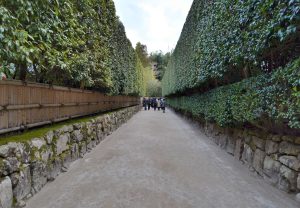
As you pass the first gate of Ginkaku-ji, the long gravel path leads you through a series of ninety-degree turns. A travel guide may tell you this dogleg is designed to confuse malevolent spirits and impede their progress, but it also serves to gently pull us into the garden’s sublime interior. It stills the body and empties the mind, so when we finally turn the corner into the garden proper and encounter its immaculate, giant cone of sand, the aesthetic shock strikes our perception—a clear bell ringing with sharp keenness in the silence of our consciousness.
Now a sub-temple of the Buddhist Rinzai sect, Ginkaku-ji (the Silver Pavilion), or Jishō-ji, as it is officially known, was built as a retirement villa late in the fifteenth century for the shogun Ashikaga Yoshimasa. Despite its informal name, it is now best known not for the wood pavilion that graces its gardens but for kogetsudai (moon-facing mound), the giant frustum of crushed granite that is immediately visible as one enters the inner gate. The grounds are a meandering, complex assemblage of views, but this feature is the garden’s site of greatest intensity. Its sudden unveiling as one enters acts as a keisaku—a jolt that shocks us into present-centred awareness.[21]
The pathway is an object lesson in designing a transitional experience, a threshold. Outside congregates a jostling throng of food vendors, school groups, and harried tourists. But once we enter the main gate and turn right, soaring hedging immediately quarantines our vision and hearing from the noise and bustle of the external world. This sensory reduction is paralleled in an aesthetic one. Stone, bamboo, and camellia are the pathway’s only materials, and they repeat in an unadorned fashion for its full length. While barely fifty meters, the apparent duration of this entry procession is elongated by its design, stretched in the horizontal plane by the narrowness of its dimensions and the taut verticality of the camellia hedging. The result is an exaggerated vanishing point that appears to lead nowhere, frustrating our human habit of expectation and our desire for novelty—the very root of suffering in Buddhist doctrine.[22]
These design elements produce an experience of aesthetic reduction. Our senses are left wanting, underfed. In Zen Buddhist metaphysics this is not seen as lack; the void is not emptiness, but is replete with latent potential and animation. Reduction here serves not as a negation of form, but to manifest śūnyatā (emptiness) in sensory perception. This lack of nourishment hastens our appetite for stimulation, concentrating the aesthetic revelation when the garden’s interior finally appears before us. Its horizontal expanse and meandering plan are intensified as our vision opens out from the entry’s constrained spatial and aesthetic qualities.
This is a path in both senses: a walking track but also a course of action, a ”do-way” or method for achieving an end. It leads us physically into the temple grounds but also transports us psychically from the profane world of the city outside to a sacred inner world of repose and contemplation. For those willing to take the journey, it leads us down, into the self.
Gingaku-ji‘s entryway is the threshold as prelude, both in spatial and in temporal terms; it stretches time to deepen perception, exemplifying how thresholds generate a zone of transition in which sensory and affective shifts are subtly but powerfully enacted. It builds a perceptual hunger. In the suspended moment before the garden’s interior is revealed, we are made receptive not only to beauty, but to an interior state attuned to it. As Okakura Kakuzō observes in The Book of Tea, “leaving something unsaid the beholder is given a chance to complete the idea… A vacuum is there for you to enter and fill up the full measure of your aesthetic emotion.”[23]
In this sense, the threshold does not only frame the sacred but produces it. The path to Ginkaku-ji provides an affordance of transformation, guiding both body and mind toward an enhanced mode of attention. It exemplifies a core idea of this discussion: that contemplative experience is not only a matter of subjective cognition, but of affordance—of a careful calibration between environment and perceiver.
8B. The genkan: thresholds of belonging

United Arrows is an upmarket Japanese clothing brand selling refined, minimal fashion. Its store in Marunouchi, situated across from the Imperial Palace, is a tasteful blend of stone, wood and LED lighting. If you try on a garment, you’ll be led to the dressing rooms, and as you step into a softly lit cubicle, you’ll hopefully notice the change in flooring from polished granite to carpet. This dividing line between stone and wool marks the most subtle of thresholds. It acts as what Ellis and Tucker describe as a micro-affordance[24]—a fine-grained perceptual cue that subtly prompts a shift in bodily behavior without the need for conscious instruction. Different stores might indicate this border in different ways—a slight shift in elevation or a thin painted line—but it is one that can be found in almost any dressing room, from budget clothing retailers to the exclusive boutiques of Ginza. This change in material signals a cue to remove one’s shoes. As with all thresholds, the transition it marks takes place both in the physical and symbolic realm. In practical terms, it is claimed to address cleanliness, preventing the soiling of the floor. Given that the floor might be stone or tile or continuous with the flooring in the rest of the store, this argument is unconvincing. Symbolically, however, this threshold demarks a transition from the public space of the store to the private sphere of the dressing room. It is a genkan in miniature.
As discussed, thresholds have the capacity to reorient our awareness. Nowhere does this more subtly play out than in the genkan, the entrance vestibule common in Japanese buildings. Though easily overlooked, this space operates as a profound spatial threshold that shapes social relations and bodily perception.
While the genkan has a practical function—providing a space to remove shoes and prevent outside dirt from entering—it also has a deeper cultural significance. Originating in Zen temples, it originally marked a transitional space between the mundane external world and the inner monastic sanctum of a Zen temple, forming an entryway to the temple’s dojo, the place (jo), where one learns the do, or ‘way.. The temple genkan was not just a buffer, but a ritualized space of transition, alerting the body and mind to a change in tenor. The samurai class’ adoption of the genkan during the late medieval period and its eventual diffusion into everyday domestic life cemented its enduring role as a spatial metaphor.[25]
This modest vestibule exemplifies the ritualization of space, transforming an ordinary environment into a site of heightened awareness through embodied action. What might easily appear mundane is here rendered significant through its particular spatial choreography. As Catherine M. Bell has noted, the “strategies of ritualization are particularly rooted in the body, specifically, the interaction of the social body within a symbolically constituted spatial and temporal environment.”[26] The act of removing one’s shoes and bowing slightly to do so, of pausing to admire the display alcove it contains, and of stepping up into the interior proper combine to form a ritual in miniature.
Shinto—Japan’s indigenous, animist religion—provides the background to the genkan’s preoccupation with cleanliness. In Shinto, there is an alignment between physical and spiritual purity (tsumi).[27] Removing one’s shoes when entering the home exemplifies this attitude, echoing the handwashing and mouth-rinsing practices found at the entrance to Shinto shrines. The genkan acts as a zone of quarantine, protecting the home (uchi) from the external world’s polluting influence (soto), both physical and moral. It is an interstitial space, neither properly inside nor out, public nor domestic, and this interstitially applies also to the social dynamic among those who occupy it. When a visitor inhabits the genkan, the conventional social requirements of host and guest are momentarily suspended.
What is striking about the genkan is how slight are the means it employs to materially orchestrate an embodied awareness. The change in flooring underfoot—from cold stone to warm wood or tatami, from rough to smooth—alters our relationship with the ground. Our proprioception is activated, and the movements of our body orchestrated, by the subtle demands of these material shifts. Such sensory prompts are not incidental but the very mechanism by which thresholds direct our perceptual attention. As Pallasmaa writes, “Architecture is the art of reconciliation between ourselves and the world, and this mediation takes place through the senses.”[28] In Merleau-Pontyian terms, this inhabitation of space is not a process of mental analysis, but one that arises through all the complexity and messiness of the body’s encounters with the material world.
The genkan is a model for how architectural thresholds function to afford contemplative states of experience. By modulating our bodily awareness and focusing our attention, the genkan creates a moment of mindful awareness that reverberates beyond its small physical footprint, embedding a rich complex of symbolic and sensory cues into an otherwise prosaic space.
8C. Shinto’s torii gate: thresholds of immanence
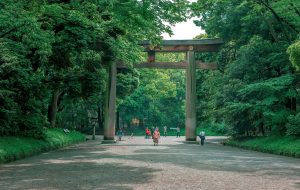
Perhaps you’re in a mountain forest, the wind’s gentle silence broken only by a crow’s solitary caw, when it reveals itself: a lone torii gate, its posts weathered gray, cut from the same cedar trees that shadow it. Or perhaps here, in Tokyo’s Aoyama district, stepping from the sleek steel and glass of the Comme des Garcons flagship store to stumble unexpectedly across the tiny Omatsu Inari Shrine. Its modest concrete torii gate and nameplate—Omatsu (small pine)—are the only lingering trace of the tree that once took root in this place.
Shinto, or kami no michi (the way of the gods), is Japan’s indigenous spiritual tradition. It is orthopraxic—one does, rather than is, Shinto—and to observe it is not to hew to a moral order set out in a sacred text, but to concern oneself with proper practice.[29] Its ritual actions permeate multiple layers of Japanese life, from the ideological foundations of national identity to seasonal festivals and domestic shrines, and it can be regarded as the foundational root from which many of the sensibilities associated with “Japaneseness” emerge—its collectivist society, concern with cleanliness, reverence for nature, and orientation toward ritual. As Thomas Kasulis explains, “Shinto recognizes the sacred in nature, in beauty, in displays of power, in special persons, in ritual and festival, in special places; in brief, within the world” and the “divine is “known through the senses and through actions.”[30] Shinto’s kami, or spirits, are not transcendent beings dwelling in an idealized realm, but immanent presences within the natural world, residing in rocks, trees, rivers, and mountains. Rather than aspiring to commune with a transcendent world, Shinto rituals work to disclose the sacredness of this one.
Among its most recognisable symbols is the torii (bird perch) gate that marks the entrance to Shinto shrines and stands as an exemplar of a contemplative threshold. It is less a physical object—it barely functions as a barrier—than a spatial and cognitive threshold to prompt passage from one mode of awareness to another, from the external material world to the internal affective one. In phenomenological terms, the torii might be understood as an intentional structure—an object that discloses the world differently through the act of perception itself. As Merleau-Ponty writes, “every perception is a communication or a communion… the complete expression outside ourselves of our perceptual powers and a coition, so to speak, of our body with things.”[31] In this way torii acts as a perceptual signpost that frames the world differently, organizing our attention as much as demarcating space.
The torii‘s designerly qualities afford this functioning. Constructed from wood, stone, concrete, or metal, its two upright posts and two horizontal lintels are often painted in a vermilion red, contrasting vividly with the greens and grays of the surrounding landscape. The simplicity of the torii’s geometry belies its aesthetic richness. Its lacquered surface gleaming, a wooden torii might form a saturated punctuation mark against the ocean’s vivid blue or the solitary ambience of a forest. A weathered stone torii, mottled with lichen, might emerge gradually from the surrounding landscape as one draws near. These visual and material qualities contribute to what Gernot Böhme terms ‘atmospheric’ experience—a space that is felt rather than rationally intellectualized and that shapes bodily comportment and mood:
Atmospheres are indeterminate above all as regards their ontological status. We are not sure whether we should attribute them to the objects or environments from which they proceed or to the subjects who experience them. We are also unsure where they are. They seem to fill the space with a certain tone of feeling like a haze.[32]
Torii often line the approach path, or sandō, that lead inward toward a Shinto shrine. These paths too are not neutral conduits, but are part of a deliberate spatial choreography that invites slowness and attention. Often composed of crushed stone, their uneven surface encourages a more mindful gait, the sound of each step a prompt toward a contemplative orientation.
Together, the torii and sandō act in unison as part of a spatialized and embodied ritual that affords the contemplative state. The path is not an inert zone, but a threshold charged with intention; not merely a conduit, but a spatial field in which form and attention arise together.
8D. The Teshima Art Museum: thresholds of the elemental

The first threshold is the island itself. With a population of under a thousand, Teshima sits four hours south of Osaka and another three from Tokyo, nestled into a corner of a small island in the Seto Inland Sea. Perhaps you’ve taken the Shinkansen from Kyoto, leaving early to avoid the peak-hour crush. Two further trains and a ferry bring you to the island, exhilarated yet weary from the long journey. From there, a bicycle ride traces an undulating, untrafficked coastal road, before gently descending through restored rice paddies to the museum, slowly revealed as if embedded in the landscape itself.
Like other destination artworks, its remote location and the time required to reach it primes us for its artistic unfolding; the museum persists as an object of focus and contemplation for many hours before it comes into view. Time expands, stretching out the museum experience far before one’s in-situ encounter. It is a pilgrimage—one that foregrounds, as John Beardsley notes, “the significance of removing ourselves from everyday life as a vehicle for contemplation,”[33] transforming physical distance into psychological readiness.
Designed by architect Ryue Nishizawa, half of the Pritzker Prize-winning practice SANAA, the Teshima Art Museum contains a single artwork: Bokei (Matrix), by Rei Naito. Yet this reductive description—museum as container for a single object—fails to capture the complex dynamic among artwork, architecture, and landscape. Their fusion creates a true gesamtkunstwerk and, I would argue, one of the great artistic experiences of the twenty-first century.
The museum’s concrete shell suggests a water droplet: roof, walls, and floor all folding into each other in uninterrupted curves. Two oval voids, the only other architectural detail, allow light, wind, rain, and birdsong to permeate the space. Pinholes in the floor release drops of water that bead and snake across the floor, pooling with other droplets, before being absorbed through unseen holes. In a few places, delicate ribbons of fabric arc down from the ceiling like spiderwebs, their movement making visible the gentle breeze. And that is the totality of the work.
Nature and architecture are so deeply interwoven that any attempt to separate them feels futile, even antagonistic to the artwork. Here, the surrounding landscape is not merely a backdrop, but an integral part of the museum’s “content.” Unlike in Judeo-Christian traditions’ anthropocentric emphasis, in Japanese culture, and Shinto in particular, humans are part of nature (shizen no ichibu), and humans and nature are seen as one body (dōtai).[34] As such, in Japanese culture the creations of human effort are seen as products of nature in as much as a bird’s nest or beaver’s dam are; “everything is nature, even architecture itself.”[35]
Both Nishizawa’s architecture and Naito’s artwork function as machines for the condensation and rearticulation of nature and atmosphere. The artwork’s water drops, drawn from an underground well, evokes the surrounding ocean, and when reabsorbed into the floor flows out into the Inland Sea to evaporate and return to the island as rain.[36] The museum architecture frames and amplifies the external world, both sensorily and conceptually. As in James Turrell’s work, an expanse of the sky is captured and condensed through the building’s ceiling apertures. The architectural curvature acts as a giant acoustic mirror, and the sounds of birdsong, and echoes of water, reverberate through the space with an almost hallucinatory clarity. Elements of nature that may have been noticed enroute to the museum, here enter into conscious awareness with startling vibrancy, fulfilling the “essential mental task of buildings” that is, bringing us into awareness of “our being-in-the-world (to strengthen) our sense of reality and self.”[37]
Paradoxically, when inside, one feels more outside than before entering. Like a bonsai tree, where a single plant evokes an entire landscape, the museum distills the natural world into an intensified, concentrated experience. This aesthetic strategy, where “details are not a part of the whole but incorporate the whole within,, is common in Japan, a culture that for centuries has refined the minute’s capacity to act as a microcosm for the larger world.[38]
The Teshima Art Museum is a masterclass in thresholds, both spatial and sensory. The ticket booth marks the first material threshold, a gateway between the car park and the museum grounds. Upon exiting, one sees the long-anticipated museum building ahead—yet the entry path, crafted with a subtle return to create the appearance of floating above the ground, sharply veers away, leading visitors on a meandering route that follows the site’s natural contours. Winding through a wilderness of trees and bamboo, the pathway opens out onto an expansive vista of the inland sea, a reduced perceptual field mirroring that of the museum. A single stainless-steel bench invites a moment’s pause, underscoring that the path is an aesthetic prelude as much as an entryway. This deferral of arrival is a kind of ritualized unfolding—a staged sequence that recalibrates perception through withholding immediacy. Water, light, sky, birdsong, and climate, all elements of the museum experience, are introduced here, immersing the visitor before their intensified reproduction within the museum’s minimal interior. At last, the path arrives at the museum’s entrance, marked by a low, concrete bench holding slippers. Here one again pauses to remove shoes, recalling the genkan threshold of a traditional Japanese home. White-robed attendants, suggestive of Shinto priests, brief visitors on the proper protocol before entering. The entryway to the museum has been designed to be as small as legally permissible, evoking a nijiriguchi (crawling-in entrance), the constrained entryway of a tea ceremony room—yet another threshold, guiding one into a heightened state of awareness.
This cascading sequence of thresholds—from the broad geography of Japan down to the intimate scale of a single bead of water—work in concert to lead us into a state of contemplative receptivity. The journey to Teshima primes our attention. Its remoteness and the lengthy journey required to reach it cultivate a kind of perceptual humility. The sinuous entry path sharpens our attentiveness. Our pace is slowed and our senses tuned to the atmospheric. Within the museum’s interior, these elemental forces are intensified and distilled into a heightened aesthetic awareness that dissolves the boundaries between self and surrounding. As our perception sharpens, the profane everyday gives way to the numinous, the thoughtless and habitual to focused immediacy.
8E. Wrapping: thresholds of revelation

Carefully crafted wrapping is not unknown in the West. Apple’s considered, minimalist packaging birthed the unboxing phenomena, transforming the opening of electronic products into a branded experience design. Luxury goods too are often encased in finely crafted or sumptuous materials. But such examples are primarily rooted in commercial imperatives, serving the thrill of consumption more than any deeper cultural or contemplative ends.
In Japanese gift culture, wrapping acts as more than container or embellishment—it is a temporally choreographed experience that tightly structures attention and the social transaction of gift giving. Often comprised of a diversity of materials and multiple layers folded in complex ways, Japanese wrapping is seldom something that can be thoughtlessly torn off; its disassembly requires focus and manual dexterity: “the entire experience is guided by the allure of the hidden or the obscured.”[39] This aesthetic of concealment has deep historical roots, echoing the cultivated restraint of the Heian court, where layered garments and veiled expressions generated allure through deferral. As Kenkō observed, in his Essays in Idleness: “Rather than gazing on a clear full moon… it is infinitely more moving to see… a moon glimpsed among cedar branches deep in the mountains, its light now hidden again by the gathering clouds of an autumn shower.”[40]
The material and aesthetic thresholds of layering and concealment act to prolong and “make difficult.” As the Russian formalist Viktor Shklovsky argues in his essay, “Art as Technique,” such a strategy of defamiliarization (ostranenie) makes the familiar newly perceptible:
The end of art is to give a sensation of the object seen, not as recognized. The technique of art is to make things ‘unfamiliar,’ to make forms obscure, so as to increase the difficulty and the duration of perception. The act of perception in art is an end in itself and must be prolonged.[41]
Framed in this way, wrapping renews one’s attentiveness and emotional clarity through deliberate difficulty and delay. Negotiating complex folds, peeling back delicate papers, and unthreading strands of bamboo extend the experience of revelation, bringing attention into the present moment. Such high levels of aesthetic refinement also build anticipation, priming the receiver to beauty and, by association, to the depth of the social interaction. We are drawn into focused contemplation—first to the gift, then to the interpersonal relationship from which it has emerged.
The material and perceptual thresholds produced by elaborate wrapping also afford social ones. A complex set of norms governs gifting, reflecting and reinforcing Japanese society’s complex balance of obligation and social hierarchies. At its core, gifting culture is deeply tied to Japanese culture’s value of social harmony and reciprocity. Giving is less about the material gift than the maintaining of social bonds and affirming one’s place within a larger network of obligations and mutual care. The value of a gift must be finely calibrated. Too expensive a gift can create a financially onerous expectation for the receiver, and so refined and considered packaging allows something modest to be given with humility, reducing reciprocal burden while still expressing esteem.
At the core of this cultural practice is the uchi (inside) / soto (outside) dichotomy discussed in above in section 7. Gift giving functions as a threshold between these states, marking shifts in relationships and signalling changes in status. A wedding gift brings someone into a new family’s uchi; a condolence gift acknowledges the passage from life to death. When visiting someone’s home, it is customary to bring a small gift known as temiyage. This practice recognizes the host’s hospitality and the guest’s status as an outsider (soto) entering an intimate space (uchi), and a carefully chosen temiyage smooths the transition from outsider to welcome guest. Similarly, Omiyage (travel souvenirs) act as a bridge between absence and presence, allowing a traveler to share the experience of travel while reintegrating into the uchi of existing social circles.[42]
In Japanese wrapping culture, packaging becomes a contemplative device that attunes our perception not only to the gift, but to the relationship it gestures toward. It acts not merely as a covering separating interior from exterior, but as a threshold dissolving social barriers between self and other.
9. Conclusion
Thresholds, as this paper has shown, are not passive markers of a spatial transition, but are active affordances with the power to alter awareness. Designed appropriately, they can suspend our familiar patterns of perception and guide us toward a contemplative mode of being, gently loosening the division between self and world. In doing so, they create the circumstances for contemplation to emerge, not as a retreat from the everyday but as an intensified encounter with the world.
Aaron Seymour
Aaron.Seymour@uts.edu.au
Aaron Seymour is a practising designer and lecturer in visual communication design at the University of Technology Sydney. He has been a frequent visitor to Japan over thirty-five years and runs design study tours for his students. His research addresses the affective and embodied dimensions of design, in addition to seeking to understand the social and political dimensions of digital technologies and how they exist as both virtual and material artefacts.
Published on February 15, 2026.
Cite this article: Aaron Seymour, “Thresholds as Affordances for Contemplation: Japanese Exemplars,” Contemporary Aesthetics, Volume 24 (2026), accessed date.
DOI: https://doi.org/10.62729/6a46870160af6
Endnotes
[1] Maurice Merleau-Ponty, Phenomenology of Perception, trans. Colin Smith (Routledge, 2002), 171.
[2] Andy Clark and David J. Chalmers, “The Extended Mind,” Analysis 58, no. 1 (1998): 7-19.
[3] Shaun Gallagher, How the Body Shapes the Mind (Oxford University Press, 2005).
[4] Alva Noë, Action in Perception (MIT Press, 2004).
[5] Merleau-Ponty, Phenomenology of Perception, 327.
[6] Shaun Gallagher, “Bodily Self-Awareness and Object-Perception,” Theoria et Historia Scientiarum 7, no. 1 (2003): 53-68.
[7] James J. Gibson, The Ecological Approach to Visual Perception (Lawrence Erlbaum, 1986).
[8] Noë, Action in Perception, 2
[9] Daisetz T. Suzuki, Mysticism: Christian and Buddhist (Routledge, 2003).
[10] James McRae, “The Art of War, the Art of Self,” New Essays in Japanese Aesthetics, edited by A. Minh Nguyen, 203–221. (Lexington Books, 2017), 126.
[11] William C. Chittick, Sufism: A Beginner’s Guide (Oneworld Publications, 2007) 43.
[12] Jon Kabat-Zinn, Wherever You Go, There You Are: Mindfulness Meditation in Everyday Life (Piatkus, 1994) 3-4.
[13] Gibson, The Ecological Approach to Visual Perception, 129.
[14] Donald A. Norman, Emotional Design: Why We Love (or Hate) Everyday Things (Basic Books, 2004).
[15] Merleau-Ponty, Phenomenology of Perception.
[16] Randall L. Nadeau, “The Japanese Religious Tradition,” The Encyclopedia of Religion, vol. 7, edited by Mircea Eliade, 89-94. (Macmillan, 2007).
[17] Sanghoon Kang, “Uchi versus Soto in a Japanese Genkan,” International Review for Spatial Planning and Sustainable Development 5, no. 4 (2007): 19-29.
[18] Joy Hendry, Understanding Japanese Society (Routledge, 2019) 43-45.
[19] Kang, “Uchi versus Soto in a Japanese Genkan.”
[20] Salvator-John A. Liotta, Matteo Belfiore, and Kengo Kumo, Patterns and Layering – Japanese Spatial Culture (Prestel Publishing, 2012).
[21] Alan Watts, The Way of Zen (Random House, 1999), 157.
[22] Daisetz T. Suzuki, Manual of Zen Buddhism (Grove Press, 1994)
[23] Kakuzō Okakura, The Book of Tea, (Dover Publications, 1906), 27.
[24] Rob Ellis and Mike Tucker, “Micro-Affordance: The Potentiation of Components of Action by Seen Objects,” British Journal of Psychology 91, no. 4 (2000): 451-471.
[25] Sandra Buckley, “Genkan,” in Encyclopedia of Contemporary Japanese Culture, ed. Sandra Buckley (London: Routledge, 2002), 170.
[26] Catherine M. Bell, Ritual Theory, Ritual Practice (Oxford University Press, 1992), 93.
[27] George Williams, Shinto (Infobase Publishing, 2009), 34.
[28] Juhani Pallasmaa, The Eyes of the Skin: Architecture and the Senses (Wiley, 2012), 77.
[29] Catherine Bell, Ritual: Perspectives and Dimensions (Oxford University Press, 1997), 192.
[30] Williams, Shinto, 130-131.
[31] Merleau-Ponty, Phenomenology of Perception, 373.
[32] Gernot Böhme, “Atmosphere as the Fundamental Concept of a New Aesthetics,” Thesis Eleven 36, no. 1 (1993): 113-126, 114.
[33] John Beardsley, “Filling a Void: Creating Contemporary Spaces for Contemplation,” in Contemporary Landscapes of Contemplation, edited by Rebecca Krinke, 55–65. (Routledge, 2005), 175.
[34] Aike P. Rots, Shinto, Nature and Ideology in Contemporary Japan (Bloomsbury, 2017), 65.
[35] Cristiana Bartolomei, Anastasia Fotopoulou, Caterina Morganti, and Giorgia Predari, “The ‘Japanese Landscape Inside’: The Transition of Architectural Spaces,” Digital Draw Connections 107 (2021): 535-562.
[36] “Experiencing Teshima Art Museum’s Special Morning Viewing Program,” Benesse Art Site Naoshima, effective April 1. https://benesse-artsite.jp/en/story/20190604-1176.html.
[37] Pallasmaa, The Eyes of the Skin: Architecture and the Senses, 11.
[38] Salvator-John A. Liotta, Matteo Belfiore, and Kengo Kumo, Patterns and Layering – Japanese Spatial Culture, 69.
[39] Yuriko Saito, “Japanese Aesthetics of Packaging,” The Journal of Aesthetics and Art Criticism 57, no. 2 (1999): 257-265, 257.
[40] Yoshida Kenkō, Chōmei Kamo, and Meredith McKinney, Essays in Idleness and Hōjōki (Penguin Classics, 2013), 88.
[41] Viktor Shklovsky, “Art as Technique,” Russian Formalist Criticism: Four Essays, edited by Lee T. Lemon and Marion J. Reis, 3-24. (University of Nebraska Press, 1991).
[42] Sandra Buckley, “Gift Giving,” in Encyclopedia of Contemporary Japanese Culture, ed. Sandra Buckley (London: Routledge, 2002), 171.